
Application Modernization Without the Big Bang: A Phased Approach to Legacy Systems
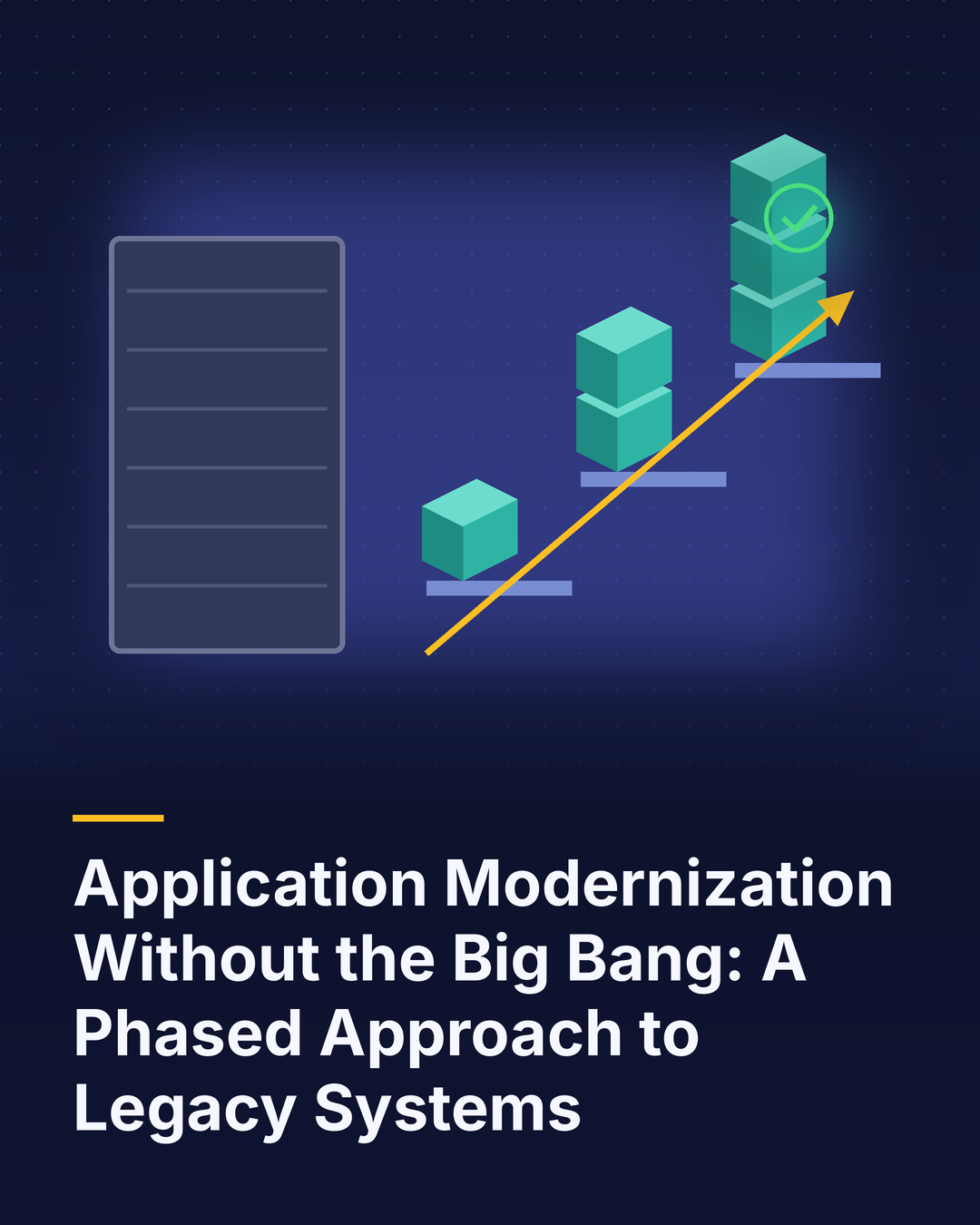
I have witnessed more than one large “big bang” replacement program in my career. The pattern is regrettably consistent. An organization decides that its aging core application must be rewritten from scratch. A multi-year program is launched with considerable fanfare. Requirements expand, timelines slip and costs rise. Meanwhile, the legacy system must still be maintained and enhanced, because the business cannot pause. Some of these programs eventually succeed. Many are scaled back, restarted or abandoned.
There is a better way, and it rests on a simple principle: modernize incrementally, delivering value at each step, while the existing system continues to operate.
Begin with an honest assessment
Not every application deserves the same treatment. A useful starting point is to assess the application portfolio against two questions: how much business value does each system provide, and how difficult is it to change? The answers suggest an appropriate path for each:
- Retain systems that work adequately and change rarely
- Rehost applications to the cloud with minimal change to gain infrastructure benefits quickly
- Replatform onto managed databases or containers to reduce operational burden
- Refactor systems where agility matters most, breaking them into modular services
- Replace commodity functions with software-as-a-service
- Retire applications that no longer justify their cost
The strangler pattern
For complex systems that must be refactored, the “strangler” approach has proven particularly effective. Rather than replacing the application all at once, new functionality is built as separate services alongside the legacy system. A routing layer directs specific requests to the new services, while everything else continues to flow to the original application. Over time, more capabilities migrate to the new architecture, until the legacy core can be retired, or reduced to a small, stable remainder.
The advantages are considerable. Each increment can be tested and delivered independently. Risk is contained to a limited scope. The business sees improvements continuously rather than waiting years for a single launch.
Enablers in the cloud
Several cloud capabilities make incremental modernization easier: container platforms and serverless services for new components; API management to expose legacy functions cleanly; managed databases and data replication to keep old and new systems synchronized; and AI-assisted tools that can analyze legacy code, document its behavior and accelerate translation into modern languages.
Organizational considerations
Incremental modernization requires sustained commitment rather than a single budget decision. Clear prioritization, stable product teams and visible metrics, such as deployment frequency, incident rates and cost per transaction, help maintain momentum. It is equally important to retain the knowledge of those who understand the legacy system, since their insight is often irreplaceable.
The bottom line
Modernization succeeds most reliably when it is treated as a continuous program of measured steps rather than a single, high-risk replacement. By assessing the portfolio honestly, applying the appropriate path to each system and using patterns that allow old and new to coexist, organizations reduce risk and deliver value throughout the journey. In my experience, patience and discipline in this work are rewarded far more consistently than ambition alone.