
AI Agents in the Enterprise: Building Systems That Act, Not Just Answer
For most of the past two years, enterprise generative AI has been largely conversational. A user asks a question, and a model produces an answer. That is useful, but it is also limited. The answer must still be read, interpreted and acted upon by a person.
AI agents represent a meaningful shift. An agent does not merely respond; it plans, retrieves information, calls tools and systems, and completes multi-step tasks toward a defined goal. In practical terms, this is the difference between an assistant that explains how to process a supplier invoice and one that actually validates it against the purchase order, flags discrepancies and routes it for approval.
What distinguishes an agent
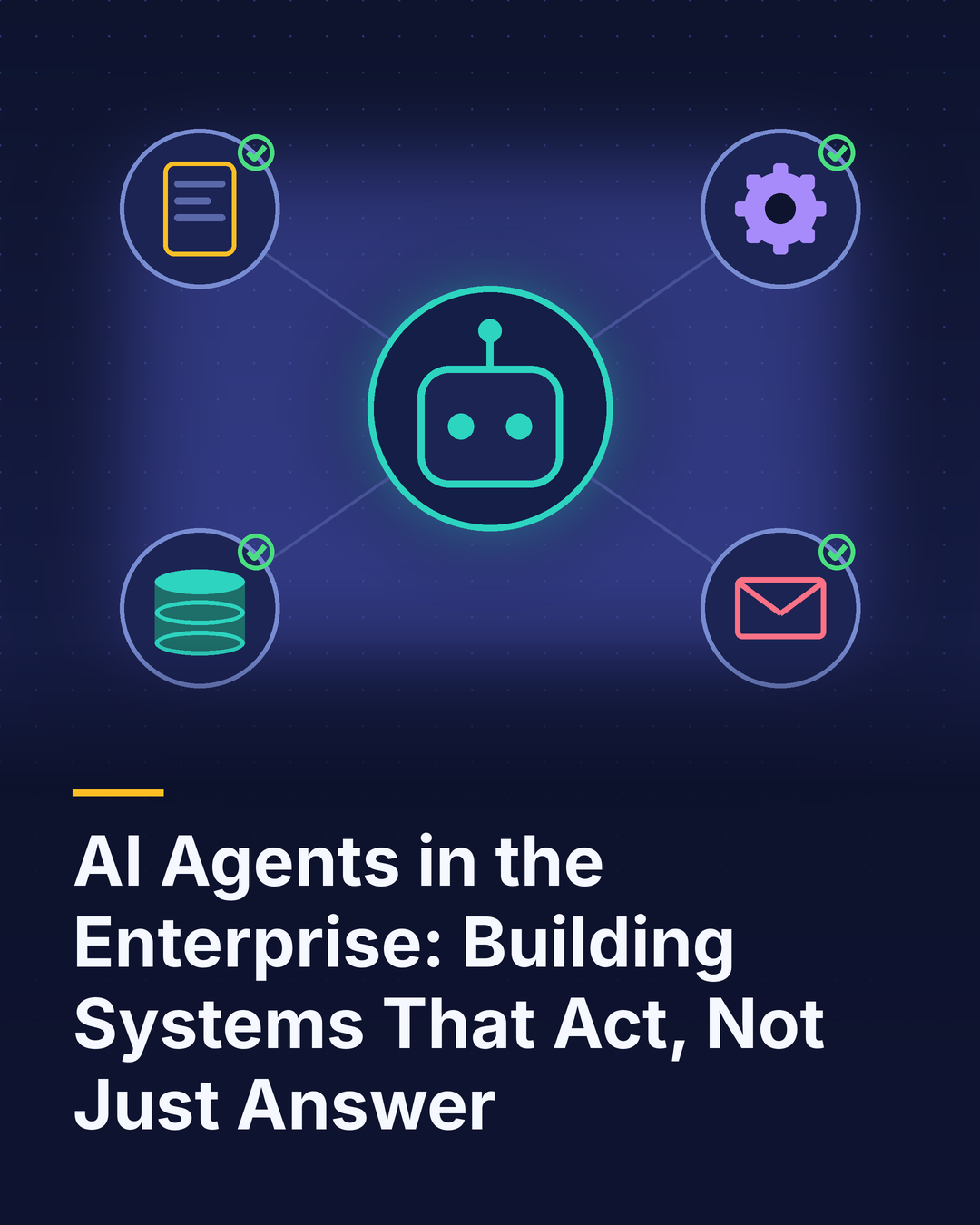
An enterprise agent requires four capabilities. It must be able to reason about a goal and break it into steps. It must have access to tools, such as APIs, databases and business applications, through which it can act. It must maintain context and memory across the steps of a task. And it must operate within defined boundaries that limit what it may do without human approval.
The fourth capability is the one most often underestimated.
Where agents are delivering value
The most successful deployments share a common characteristic: they automate well-understood, high-volume processes with clear rules and measurable outcomes. Examples include customer service resolution for common requests, IT service desk triage, procurement and invoice processing, sales research and account preparation, and data analysis tasks that combine several sources.
In each case, the agent handles the repetitive coordination work, while people remain responsible for judgment, exceptions and accountability.
Engineering for reliability
Building agents is closer to software engineering than to prompt writing. Organizations should define the tools an agent may use with precision, apply the principle of least privilege to every integration, and log each decision and action for audit purposes. Systematic evaluation is essential, because errors in a multi-step process can compound in ways that a single answer cannot.
Managed cloud platforms are particularly valuable here. Agent frameworks, integrated model access, secure connectors to enterprise systems and built-in observability remove a considerable amount of undifferentiated engineering effort, allowing teams to concentrate on business logic and governance.
The bottom line
Agents move AI from advising to acting, and that shift carries both significant opportunity and genuine responsibility. Organizations that begin with bounded, measurable processes and engineer carefully for control and observability will realize real productivity gains. Those that grant broad autonomy prematurely are likely to encounter costly errors. The prudent course is to expand an agent’s authority gradually, in step with demonstrated reliability.