
Breaking Down Data Silos: How a Unified Data Cloud Speeds Decisions
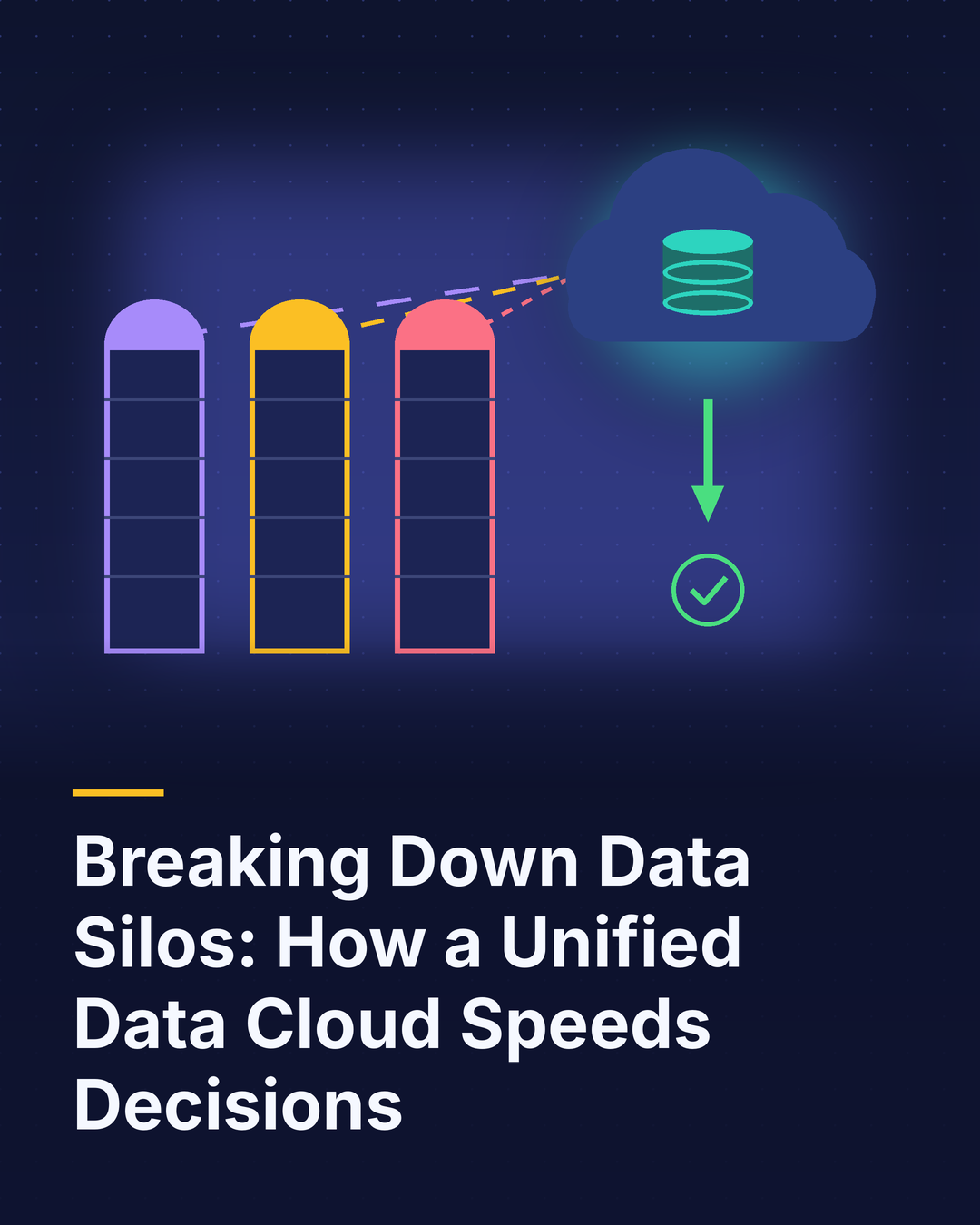
Consider a question that most executives have asked at some point: “Which of our customers are most profitable, and how is that changing?” It appears straightforward. In many organizations, answering it takes weeks. Sales data sits in the CRM, revenue in the finance system, service costs in the support platform and product usage in yet another database. Each is owned by a different department, defined in a different way and reported on a different schedule.
By the time the analysis is assembled, reconciled and debated, the moment for decision may well have passed.
Silos are as much organizational as technical
Data silos usually arise from sensible local decisions. Each department selects systems that serve its own needs. Over the years, however, the enterprise accumulates dozens of isolated data stores, each with its own definitions of fundamental concepts such as “customer,” “order” or “active account.”
The technical consequence is fragmentation. The organizational consequence is more serious: leaders lose confidence in the numbers, meetings are spent disputing whose figures are correct, and decisions default to intuition.
What a unified data cloud changes
Bringing data together on a shared cloud platform addresses the technical dimension directly. Information from operational systems flows into a common environment, where it can be joined, analyzed and governed consistently. Cross-functional questions that once required weeks of manual reconciliation can be answered in hours or minutes.
Modern platforms also allow data to be shared securely across departments, subsidiaries and even external partners without creating additional copies. Each team retains ownership of its data while making it available to others under defined permissions.
Agreeing on meaning
Technology alone will not resolve disagreements about definitions. Organizations should establish a shared business glossary and a governed semantic layer, so that metrics such as revenue, margin and churn are calculated identically wherever they appear. Assigning clear ownership for each key data domain, with responsibility for its quality and documentation, is equally important.
Start with a decision, not a data inventory
Rather than attempting to integrate every system at once, organizations should begin with a small number of important business decisions that are currently slowed by fragmented data. Integrating the data those decisions require demonstrates value quickly and builds momentum for broader consolidation.
The bottom line
Data silos impose a quiet but considerable cost on every organization: slower decisions, duplicated effort and diminished trust in information. A unified data cloud, supported by shared definitions and clear ownership, allows leaders to act on a single, consistent view of the business. In an environment where the speed of decision-making is increasingly a competitive differentiator, that capability is of considerable strategic value.