
Choosing the Right AI Model: Balancing Performance, Cost and Control
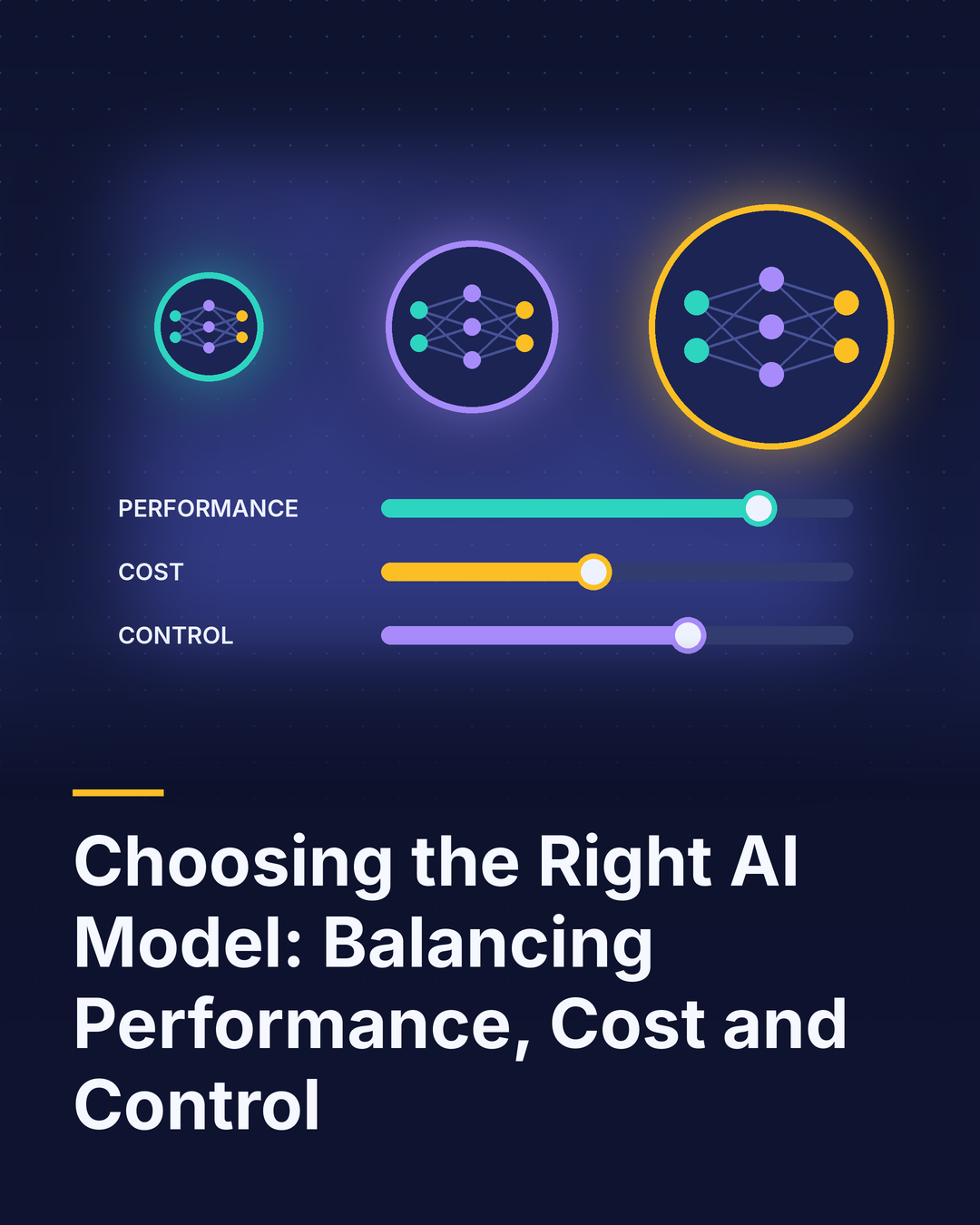
There was a time, not very long ago, when selecting an AI model was a relatively simple matter. A handful of options existed, and most organizations defaulted to whichever was considered the most capable. That period has passed. Enterprises now face a wide and rapidly changing landscape of large and small models, proprietary and open models, general-purpose and specialized models, each with different strengths, costs and operational implications.
I am frequently asked which model is “the best.” The honest answer is that the question is poorly framed. The appropriate question is which model is best suited to a particular task, under particular constraints.
The three dimensions of the decision
Performance. Larger, more capable models generally excel at complex reasoning, nuanced writing and multi-step analysis. Yet many enterprise tasks, such as classification, extraction, summarization of routine documents and simple question answering, do not require that level of capability. A smaller model may perform the task equally well, and considerably faster.
Cost. Inference costs scale with usage, and at enterprise volumes the difference between models can be substantial. A model that costs several times more per request may be entirely justified for a high-value legal analysis, and entirely wasteful for routing customer emails. Latency, which affects user experience and throughput, should be considered alongside price.
Control. Some organizations require that models run within particular regions, on dedicated infrastructure, or under specific contractual and data-handling terms. Others wish to fine-tune models or host open-weight models themselves for reasons of customization or sovereignty. These requirements can narrow the field considerably.
Evaluate against your own work
Public benchmarks are informative, but they rarely reflect the specific tasks, terminology and quality expectations of a given business. I strongly recommend building a representative evaluation set drawn from real use cases, with clear criteria for what constitutes a good answer. Candidate models can then be compared on accuracy, consistency, latency and cost under realistic conditions.
This evaluation set should not be discarded after the initial selection. Models improve and change frequently, and a well-maintained evaluation harness allows an organization to reassess its choices quickly and with evidence.
Avoid premature commitment
One of the more valuable properties of a mature cloud AI platform is access to a broad catalog of models, both first-party and third-party, through consistent interfaces, security controls and billing. This allows organizations to use different models for different tasks, and to change models as requirements evolve, without rebuilding their applications. An architecture that abstracts the model behind a stable interface is, in my view, a prudent design choice.
Many mature systems already employ several models in combination: a smaller model to classify or route requests, and a larger one reserved for the cases that genuinely require it.
The bottom line
There is no single correct model for an enterprise, only appropriate choices for specific tasks. Organizations that evaluate models against their own workloads, weigh performance against cost and control, and retain the flexibility to change will make better decisions than those that simply select the most prominent option. As the model landscape continues to evolve at considerable pace, that flexibility may prove to be the most valuable asset of all. I would encourage technology leaders to treat model selection as an ongoing discipline rather than a one-time procurement decision.