
Connecting the Front Office to the Back Office to Resolve Customer Issues Faster
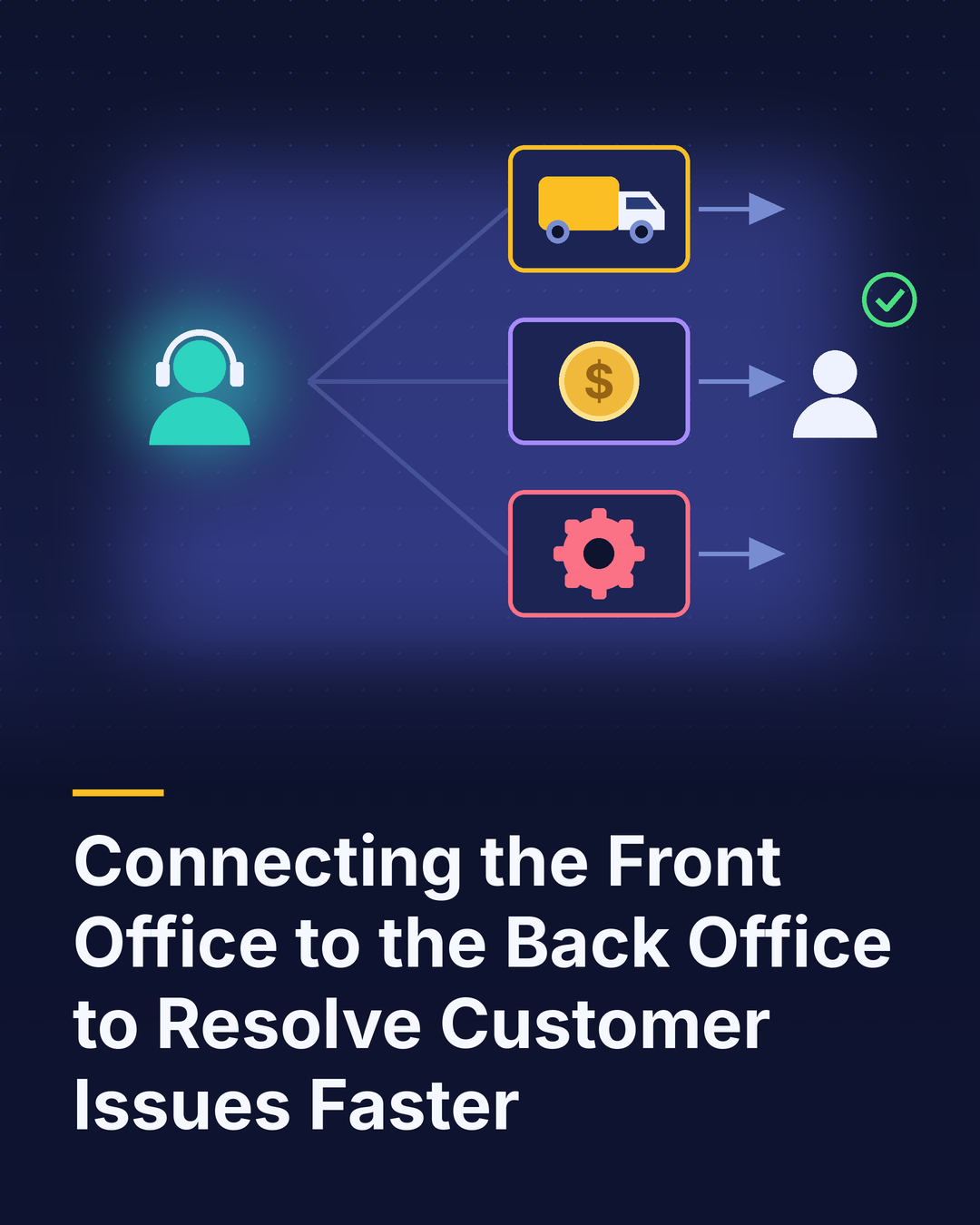
Customer service organizations have invested heavily in the front office over the past two decades. Contact centers have adopted omnichannel platforms, chat, social media support and increasingly sophisticated customer relationship management systems. Agents can see a customer’s history, preferences and previous interactions in considerable detail. Yet customers frequently remain dissatisfied, for a simple reason: the agent who understands the problem often cannot resolve it.
Where Customer Issues Actually Get Resolved
A large proportion of customer issues cannot be fixed by the service agent alone. A billing error requires action from finance. A delayed shipment involves logistics or a supplier. A product fault may need engineering investigation or a field service visit. An outage requires the operations team.
In many organizations, the connection between the agent and these back-office teams consists of an email, a shared mailbox or a ticket in a separate system the agent cannot see. The agent promises to follow up, the customer waits and the issue disappears into a process neither of them can observe. When the customer calls again, a different agent must reconstruct the situation from the beginning.
The Cost of the Disconnect
This gap produces several familiar symptoms.
- Repeat contacts as customers call back to ask for updates
- Long resolution times driven by waiting between departments rather than actual work
- Inconsistent answers because agents lack visibility into what the back office is doing
- Agent frustration at being unable to help customers effectively
- Missed root causes because recurring issues are never connected to their source
Building an End-to-End Customer Service Workflow
The solution is to treat customer service as a single process that spans the front, middle and back office, rather than as a contact center function that hands off to others. Several capabilities support this approach.
- Shared case management. When a case requires back-office action, the workflow creates linked tasks for the relevant teams on the same platform. The agent and the customer can both see progress without making further inquiries.
- Integrated service-level tracking. Commitments made to the customer are reflected in the targets assigned to every team involved, not only the contact center.
- Connected operational data. Linking customer cases to product, asset and service data allows teams to identify, for example, that many complaints relate to a single component or an ongoing service issue.
- Automated communication. Customers receive proactive updates as their case progresses, reducing the need to call.
From Case Resolution to Problem Prevention
Once front and back offices share data, organizations can move beyond resolving individual cases toward eliminating the causes of entire categories of complaints. A pattern of similar cases can trigger a problem investigation in engineering or operations, and the eventual fix can be communicated to every affected customer automatically.
The Bottom Line
Customer service quality depends as much on the back office as on the contact center. Connecting the two through shared workflows, case management and data allows organizations to resolve issues faster, reduce repeat contacts and give agents the ability to keep their promises. It also creates the visibility needed to prevent recurring problems altogether. Organizations that make this connection will find that customer satisfaction improves not because agents work harder, but because the entire enterprise finally works together on the customer’s behalf.