
FinOps for the AI Era: Controlling Cloud Costs as Workloads Grow
One of the cloud’s greatest strengths is also one of its most persistent management challenges. Resources can be provisioned in minutes by anyone with the appropriate permissions, and they are billed continuously until someone remembers to remove them. In the traditional data center, capacity was constrained by procurement cycles. In the cloud, the only constraint is discipline.
FinOps, the practice of bringing financial accountability to variable cloud spending, emerged to provide that discipline. It has matured considerably over the past several years. Artificial intelligence, however, is now introducing cost dynamics that require the practice to evolve once again.
Why AI changes the cost picture
AI workloads differ from conventional applications in several important respects.
Accelerator costs are substantial. GPU and other accelerator capacity is considerably more expensive than general-purpose compute, and idle or underutilized accelerators represent a significant waste.
Inference costs scale with usage. A generative AI feature that is lightly used during a pilot may become very expensive once it is embedded in a popular application. Costs are driven by the number of requests, the length of prompts and responses, and the choice of model.
Costs are harder to predict. Agentic systems that make multiple model calls per task, or retrieval systems that add context to every prompt, can increase consumption in ways that are not immediately apparent.
Ownership is often unclear. AI experiments frequently begin in innovation teams without the cost allocation practices applied to production systems.
Core FinOps practices, applied to AI
The fundamentals of FinOps remain sound. They must simply be applied with greater rigor.
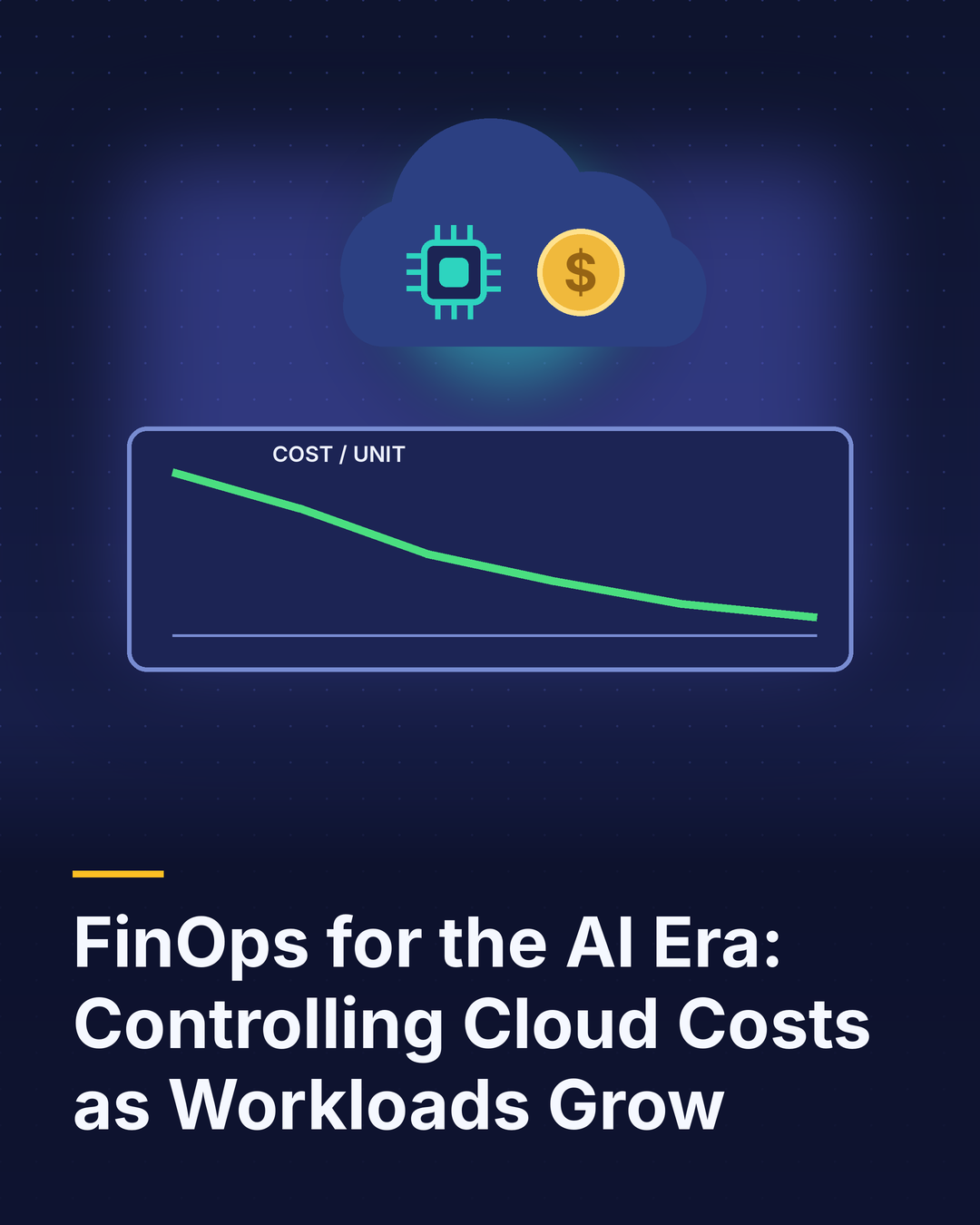
Visibility and allocation. Every resource and AI service should be tagged to a team, product or use case, so that costs can be attributed accurately. Unit economics, such as the cost per customer interaction or per document processed, are far more meaningful than total spend alone.
Model selection by value. Not every task requires the most capable and expensive model. Routing simpler requests to smaller, more efficient models can reduce inference costs dramatically with little loss in quality.
Efficient prompting and caching. Shorter prompts, reuse of common context through caching, and batching of non-urgent requests all reduce consumption.
Rightsizing and commitments. Accelerator capacity should be matched to actual utilization, with committed-use or reserved pricing applied to stable baseline demand and on-demand capacity reserved for peaks.
Budgets and alerts. Guardrails that alert teams, or limit spending, when consumption exceeds expectations prevent unpleasant surprises at month end.
A collaborative discipline
FinOps succeeds when engineering, finance and business leaders share responsibility. Engineers need cost information within their own tools; finance needs forecasts it can rely upon; and business leaders need to understand the value each investment delivers.
The bottom line
AI is likely to become one of the largest and fastest-growing components of enterprise cloud spending. Organizations that extend their FinOps practices to AI, measuring unit economics, selecting models deliberately and allocating costs clearly, will be able to scale their ambitions without losing financial control. Cost discipline introduced early is far easier to sustain than discipline imposed after budgets have already been exceeded.