
How AIOps Is Helping IT Teams Predict Outages Before Users Notice
Modern IT environments generate an extraordinary volume of operational data. Servers, containers, networks, applications and cloud services emit metrics, logs and events continuously. In principle, this data contains early warning signs of nearly every outage. In practice, the volume is so great that human operators cannot possibly examine it all, and the warning signs are lost among thousands of routine alerts.
AIOps, the application of artificial intelligence to IT operations, addresses this challenge directly.
The Alert Fatigue Problem
Operations teams in many organizations receive far more alerts than they can investigate. A significant proportion are duplicates, symptoms of the same underlying issue or simply noise. Over time, operators learn to ignore many alerts, which creates an obvious risk: the one alert that matters may be dismissed along with the rest.
What AIOps Does
AIOps platforms apply machine learning to operational data in several ways.
- Noise reduction. Duplicate and related alerts are grouped into a single, meaningful incident, often reducing alert volume dramatically.
- Anomaly detection. Rather than relying solely on static thresholds, the system learns normal behavior for each metric and identifies deviations that may indicate emerging problems.
- Correlation and root cause analysis. By combining event data with service maps and recent change records, the platform can suggest the most probable cause of an issue.
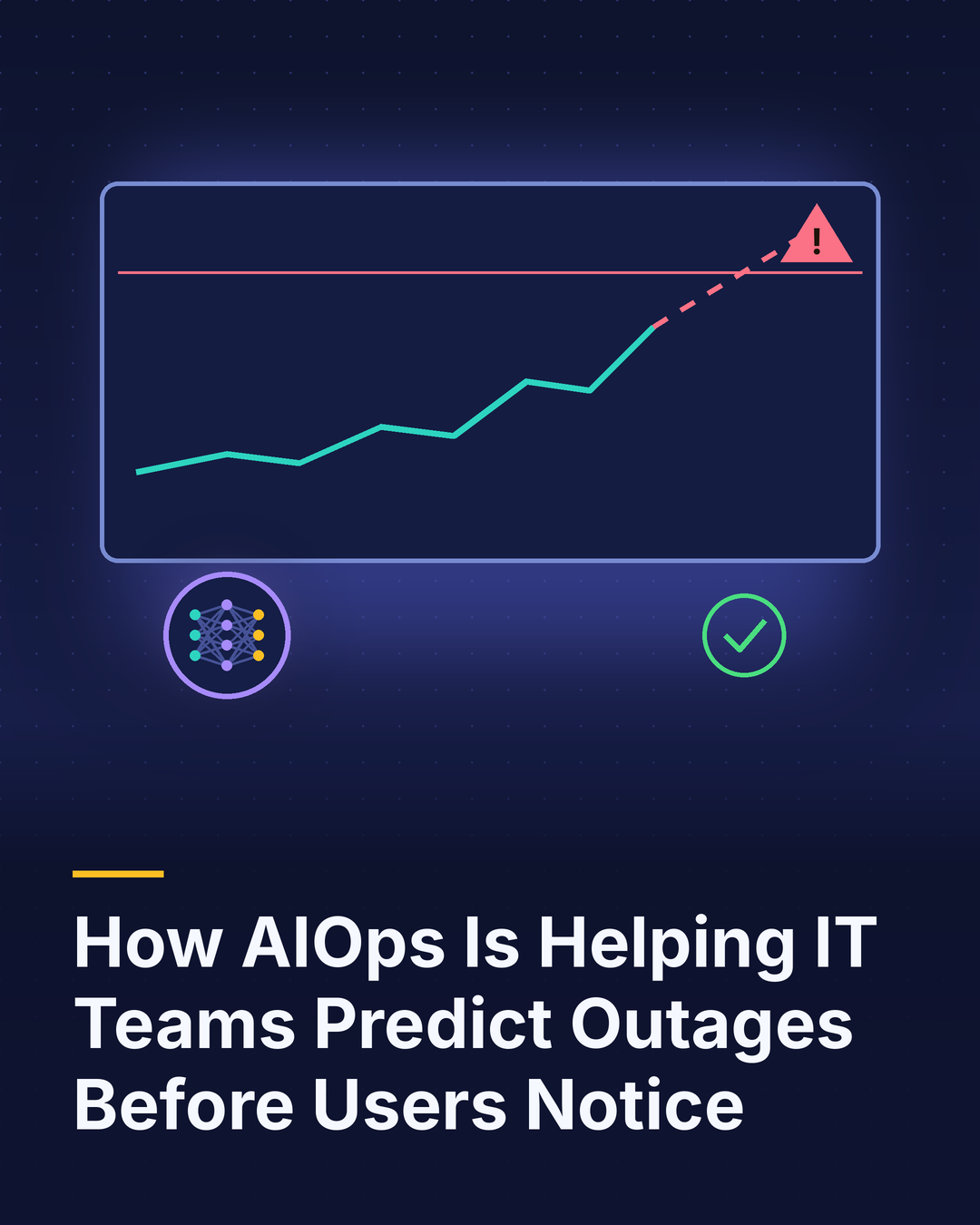
- Prediction. Trends such as gradually increasing memory consumption or rising error rates can be projected forward to forecast a failure before it occurs.
- Automated remediation. For well-understood conditions, the platform can trigger corrective actions automatically, such as restarting a service or scaling resources.
Integration Determines Value
AIOps delivers its greatest benefit when it is connected to the broader service management process. An anomaly detected by a monitoring tool is useful. An anomaly that automatically creates an incident, identifies the affected business service, notifies the responsible team and attaches relevant knowledge articles is considerably more useful. Integration with configuration data and change records is particularly important, since a large share of incidents follow a recent change.
Adopting AIOps Sensibly
Organizations achieve the best results by starting with noise reduction and correlation, which deliver immediate relief to operations teams, before progressing to prediction and automated remediation. Trust in automated actions should be built gradually, beginning with low-risk remediations and expanding as confidence grows.
The Bottom Line
AIOps allows IT teams to find the signal within an overwhelming volume of operational data, detecting and often preventing outages before users are affected. Its value depends on integration with service maps, change records and incident workflows, which turn insight into coordinated action. As IT environments continue to grow in scale and complexity, the ability to anticipate problems rather than merely react to them will become a defining capability of effective operations teams.