
Mainframe to Cloud: Practical Paths for Modernizing Core Business Systems
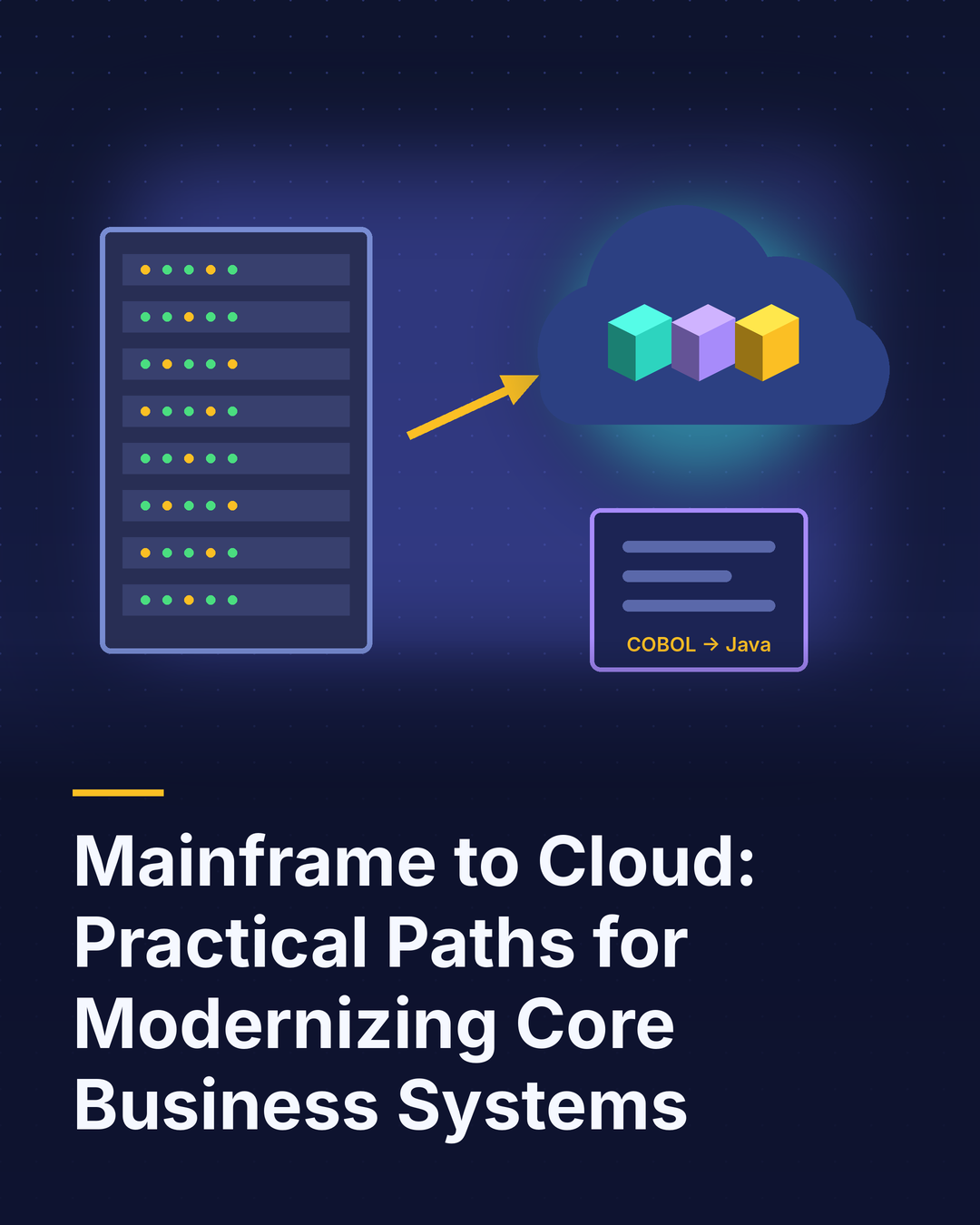
The mainframe is frequently described as a relic. That description does it a considerable injustice. Mainframes continue to process an enormous share of the world’s banking transactions, insurance policies, airline reservations and government records, and they do so with remarkable reliability. Many of the COBOL applications running on them encode decades of carefully refined business rules.
Why, then, are so many organizations seeking to modernize them? The reasons are rarely technical failure. They are cost, agility and people. Mainframe licensing and maintenance are expensive. Changing these applications can be slow, which constrains the business. And perhaps most pressingly, the engineers who understand these systems are approaching retirement, while relatively few younger professionals are learning the necessary skills.
There is no single path
Mainframe modernization is not one decision but a spectrum of options, and most organizations will use several in combination.
Integrate and extend. Expose mainframe functions through APIs and replicate mainframe data to the cloud in near real time. The core system remains in place, but its data becomes available for modern analytics and AI, and new digital services can be built around it. This is often the lowest-risk first step.
Rehost. Move existing applications, largely unchanged, onto emulation or compatible runtime environments in the cloud. This can reduce infrastructure costs relatively quickly, though the applications themselves remain in their original languages.
Refactor or translate. Convert application code into modern languages such as Java, often with automated tools. AI-assisted analysis has made notable progress here, helping to document legacy logic and accelerate translation, although careful testing remains essential.
Rewrite or replace. Re-engineer applications as cloud-native services, or replace them with commercial software. This offers the greatest long-term flexibility, but also the greatest risk and effort.
Principles for success
Having observed several such programs, I would emphasize the following.
Begin with data. Making mainframe data available in a modern cloud data platform delivers early value and reduces dependence on the mainframe for reporting and analytics.
Proceed incrementally. Migrate discrete workloads or business functions one at a time, running old and new in parallel and comparing results rigorously before switching over.
Capture institutional knowledge early. Document business rules and involve experienced mainframe staff as partners, not obstacles. Their understanding is invaluable.
Test exhaustively. Core systems demand exceptional accuracy. Automated regression testing, comparing outputs between legacy and modernized systems, is essential.
The bottom line
Mainframe modernization is a long journey rather than a single project, and the most successful organizations treat it accordingly. By liberating data first, choosing the appropriate path for each workload and proceeding in measured, well-tested increments, they reduce cost and risk while gaining agility. The urgency created by retiring expertise is real, and I would encourage leaders to begin planning now, while the people who understand these systems are still available to guide the transition.