
Measuring Customer Service Success Beyond Average Handle Time
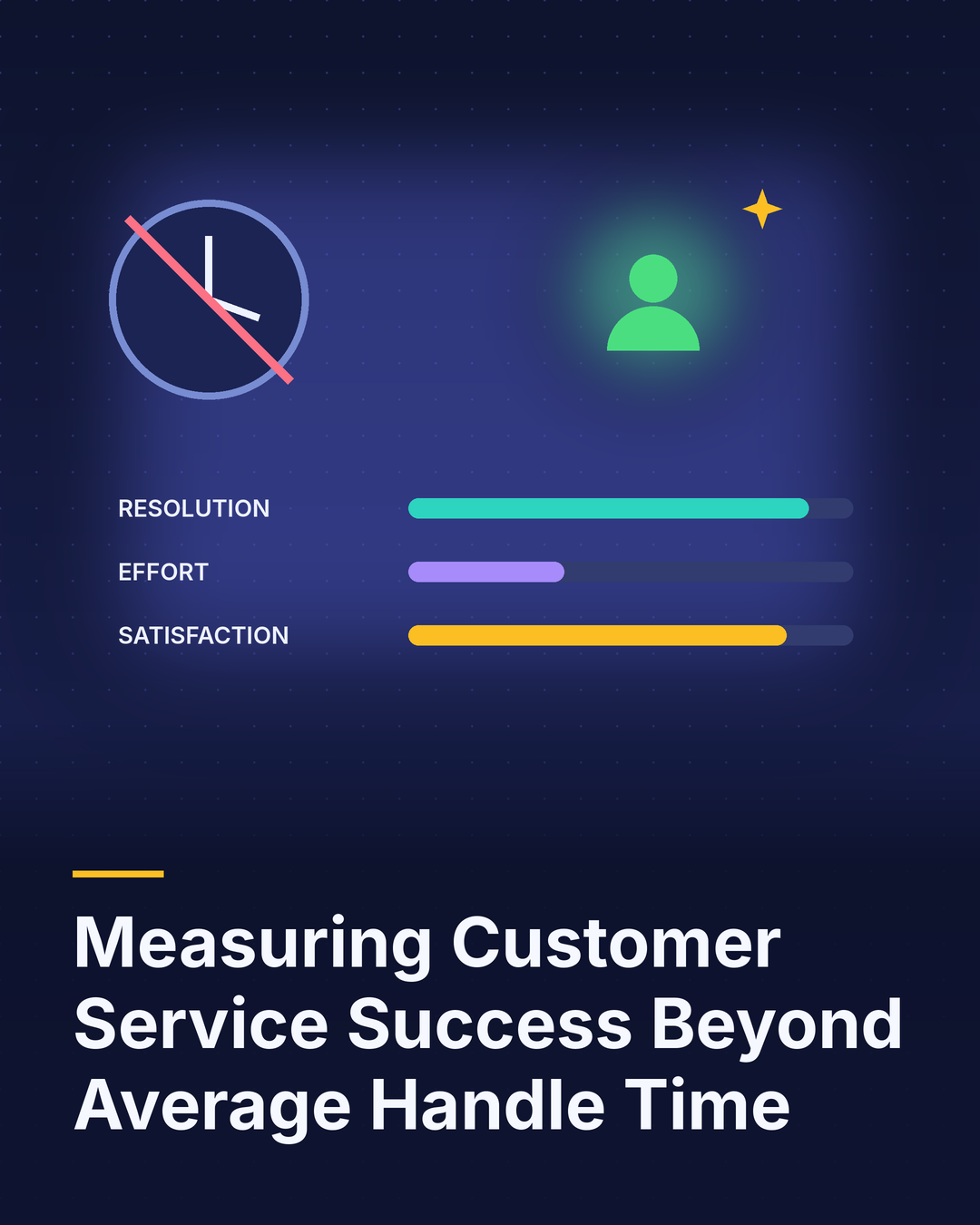
Average handle time has been a cornerstone of contact center management for as long as I can remember. It is easy to measure, easy to compare and closely linked to staffing costs. For organizations focused primarily on efficiency, it has long served as the principal indicator of performance.
The difficulty is that handle time, on its own, says very little about whether customers are well served. Indeed, an excessive focus on it can actively undermine service quality.
The Problem With Optimizing for Speed Alone
When agents are measured chiefly on how quickly they complete interactions, their behavior adapts accordingly. They may end calls before an issue is fully resolved, transfer complex cases rather than working through them or avoid investigating root causes. The interaction appears efficient, but the customer calls back, sometimes several times, and the total cost of resolving the issue increases.
A short interaction that fails to solve the problem is not efficient. It is simply deferred work.
A More Balanced Set of Measures
A modern customer service scorecard should reflect outcomes as well as activity. Several measures deserve prominence.
- First contact resolution. The proportion of issues resolved without the customer needing to make further contact. This is often the strongest single predictor of satisfaction.
- Total time to resolution. The elapsed time from first contact to final resolution, including back-office work, which reflects the customer’s actual experience.
- Customer effort. How easy the customer found it to get their issue resolved. Effort is closely associated with loyalty.
- Customer satisfaction and sentiment. Survey results, supplemented increasingly by AI analysis of sentiment across interactions.
- Repeat contact rate. How often customers return about the same issue, which reveals unresolved problems.
- Self-service success. The share of issues customers resolve without agent involvement.
- Contact prevention. Reductions in demand achieved by fixing the root causes of common issues.
Measuring the Whole Journey
Many of these measures depend on visibility across departments. Total time to resolution, for example, cannot be measured if the contact center has no insight into the back-office work required. Organizations that manage customer service on a platform connecting front and back office can measure the complete journey and identify where delays actually occur.
Using Handle Time Appropriately
None of this means abandoning handle time. It remains valuable for capacity planning and for identifying training opportunities. In my view, it should simply be one measure among many rather than the measure by which agents and teams are principally judged.
The Bottom Line
Average handle time measures how quickly interactions are completed, not whether customers are well served. A balanced scorecard that emphasizes first contact resolution, total time to resolution, customer effort, repeat contacts and prevention provides a far more accurate picture of service performance. Changing what is measured changes behavior, encouraging agents and teams to solve problems properly rather than quickly. In my experience, organizations that make this shift typically find that costs fall as well, because resolving issues properly the first time is ultimately the most efficient approach of all.