
The Hidden Cost of Manual Handoffs Between Departments
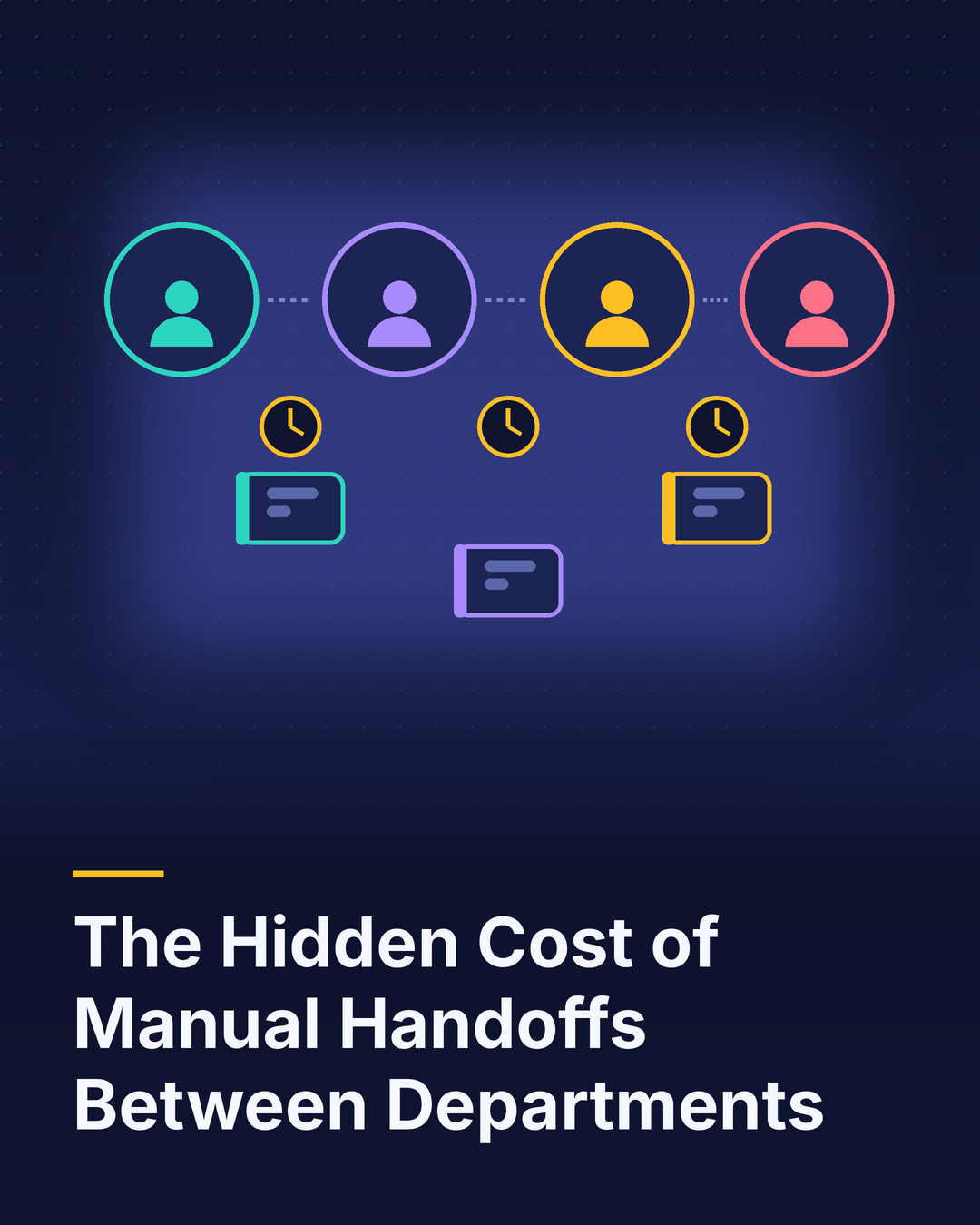
Some years ago, I was asked to examine why a mid-sized organization took nearly three weeks to provide a new employee with a working laptop and system access. Each department involved insisted that its own part of the process took only a day or two. They were correct. The problem was not the work itself. It was the time the request spent waiting between departments, in inboxes and queues, with no one quite certain whose turn it was.
That experience has stayed with me, because the pattern is remarkably common. Manual handoffs are among the most significant and least visible sources of cost in the enterprise.
Why Handoffs Are So Expensive
A handoff occurs whenever work passes from one person, team or system to another. Each transfer introduces risk and delay.
- Waiting time. Work sits idle until the receiving party notices it and has capacity to act. In many processes, waiting time exceeds working time by a wide margin.
- Information loss. Details are omitted or misunderstood when information is re-keyed or summarized in an email. The receiving team must then seek clarification, adding further delay.
- Duplicated effort. The same data is entered into multiple systems by different people, each with an opportunity to make an error.
- Diluted accountability. When a process spans several departments, no one owns the outcome. Each team optimizes its own step while the end-to-end experience deteriorates.
These costs rarely appear in any budget. They are absorbed as lost productivity, employee frustration, customer dissatisfaction and, occasionally, compliance failures.
Making the Invisible Visible
The first step in addressing handoff costs is measurement. Most organizations measure the performance of individual teams, but few measure the elapsed time of a complete process from request to fulfillment. Once that end-to-end measure is in place, the gap between working time and total time becomes evident, and the conversation changes considerably.
Process mining tools and workflow analytics can help by reconstructing how work actually flows across systems, revealing where requests wait and how often they are returned for rework.
Replacing Handoffs With Orchestration
The remedy is not simply to ask departments to respond more quickly. It is to redesign the process so that a workflow platform orchestrates the transfers automatically. When a request is submitted, the platform captures complete information once, routes tasks to each team in parallel where possible, tracks service levels and escalates when a step is overdue. Each team still performs its specialist work, but the platform, rather than an individual, manages the movement between them.
In my experience, organizations that adopt this approach typically see the largest gains not from faster individual tasks, but from eliminating waiting time and rework. Parallel processing alone can reduce elapsed time dramatically, because tasks that were once performed in sequence, for no particular reason, can proceed simultaneously.
The Bottom Line
Manual handoffs impose a substantial cost on the enterprise, yet that cost is largely invisible because it falls between departments rather than within them. Measuring processes end to end exposes the problem, and orchestrating work through a common workflow platform addresses it. The organization I mentioned at the outset eventually reduced its onboarding time from three weeks to a few days, without asking any department to work harder. It simply stopped asking people to act as the connective tissue between systems. That lesson applies to almost every cross-functional process in the enterprise.