
The Modern Data Platform: Unifying Analytics and AI on One Foundation
For much of my career, enterprise data architecture has been characterized by separation. Operational databases ran the business. A data warehouse, populated by overnight batch jobs, served reporting and analysis. Later came data lakes for unstructured and semi-structured information, followed by separate environments for data science and machine learning. Each layer had its own tools, its own copies of the data and frequently its own team.
This arrangement was a reasonable response to the technical constraints of its time. It is, however, increasingly ill-suited to the demands of modern analytics and, in particular, to artificial intelligence.
The cost of fragmentation
When data is spread across many disconnected systems, several problems follow. The same information is copied repeatedly, creating inconsistencies and raising storage and governance costs. Pipelines between systems become fragile and expensive to maintain. Analysts and data scientists spend a disproportionate share of their time locating, reconciling and preparing data rather than analyzing it. Perhaps most significantly, AI initiatives are delayed or compromised because the data they require is scattered, inconsistent or inaccessible.
What a unified platform provides
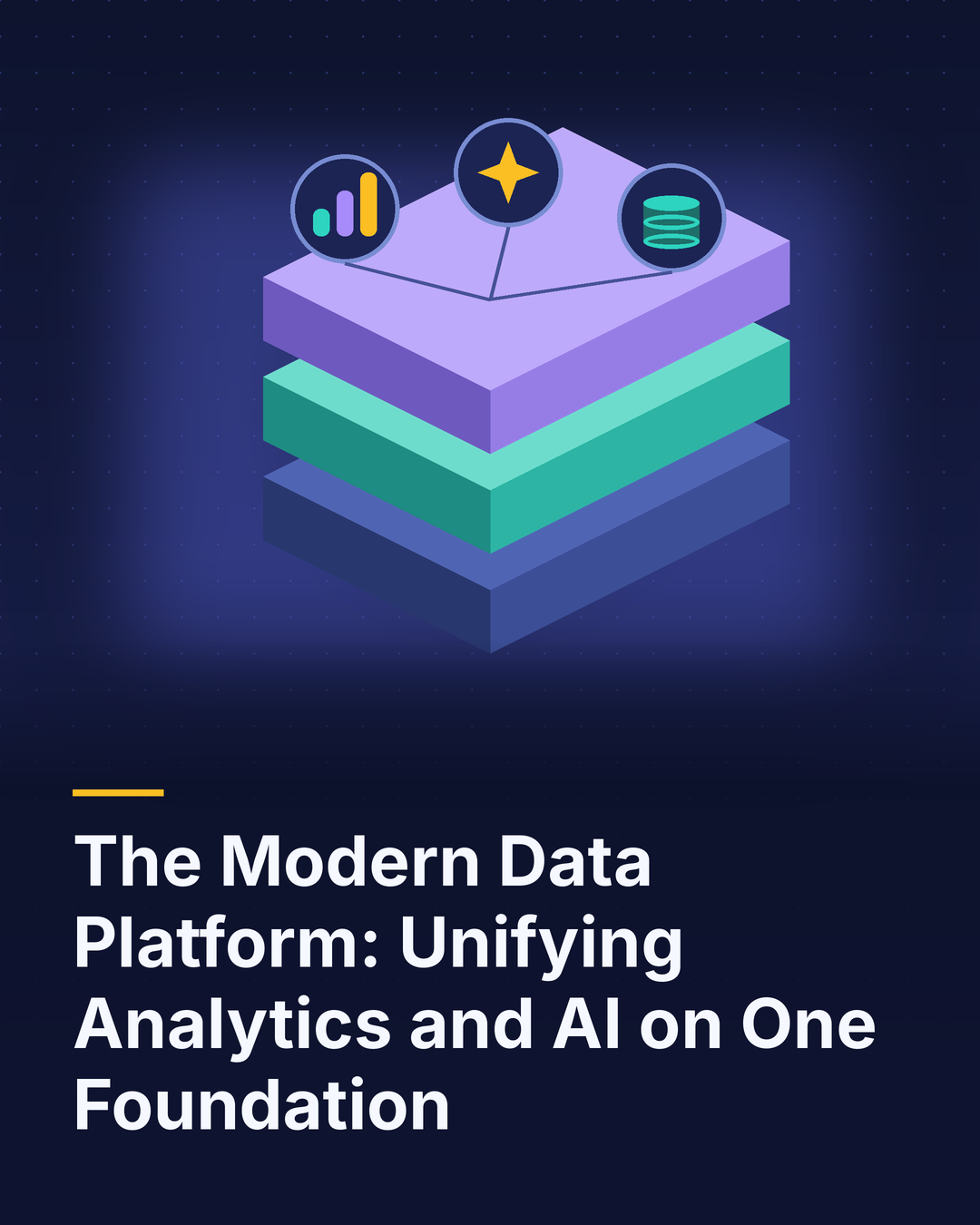
A modern data platform consolidates these capabilities on a common foundation in the cloud. Its essential characteristics are:
Separation of storage and compute. Data is stored once, at low cost, and processing resources scale independently according to demand. Multiple teams and workloads can operate on the same data simultaneously without competing for capacity.
Support for all data types. Structured tables, semi-structured logs and events, and unstructured documents, images and audio can be stored and queried together, often through open table formats that avoid proprietary lock-in.
Integrated analytics and AI. Machine learning models can be trained and invoked directly where the data resides, and generative AI can be applied to analysis without exporting data to separate environments.
Unified governance. A single catalog, consistent access controls, lineage tracking and data quality monitoring apply across the entire estate, which is essential for regulatory compliance and for trustworthy AI.
Real-time and batch processing together. Streaming data can be analyzed as it arrives, alongside historical information.
Approaching the transition
Consolidation need not be undertaken all at once. In my experience, the most successful programs begin by identifying high-value analytical and AI use cases, migrating the data those use cases depend upon, and establishing governance standards from the outset. Legacy systems can then be retired progressively as their workloads move to the new platform.
It is equally important to address the organizational dimension. Clear data ownership, shared definitions and a culture that treats data as a product will determine whether the platform delivers its potential.
The bottom line
Artificial intelligence has exposed the limitations of fragmented data architectures more clearly than any previous technology. A unified cloud data platform reduces duplication, simplifies governance and gives analytics and AI direct access to trusted information. Organizations that build this foundation will find each subsequent initiative faster and less costly to deliver. Those that continue to manage a patchwork of disconnected systems will, I suspect, find their AI ambitions constrained by their data long before they are constrained by the models.