
The Rise of the AI Control Tower: Managing Agents Across the Enterprise
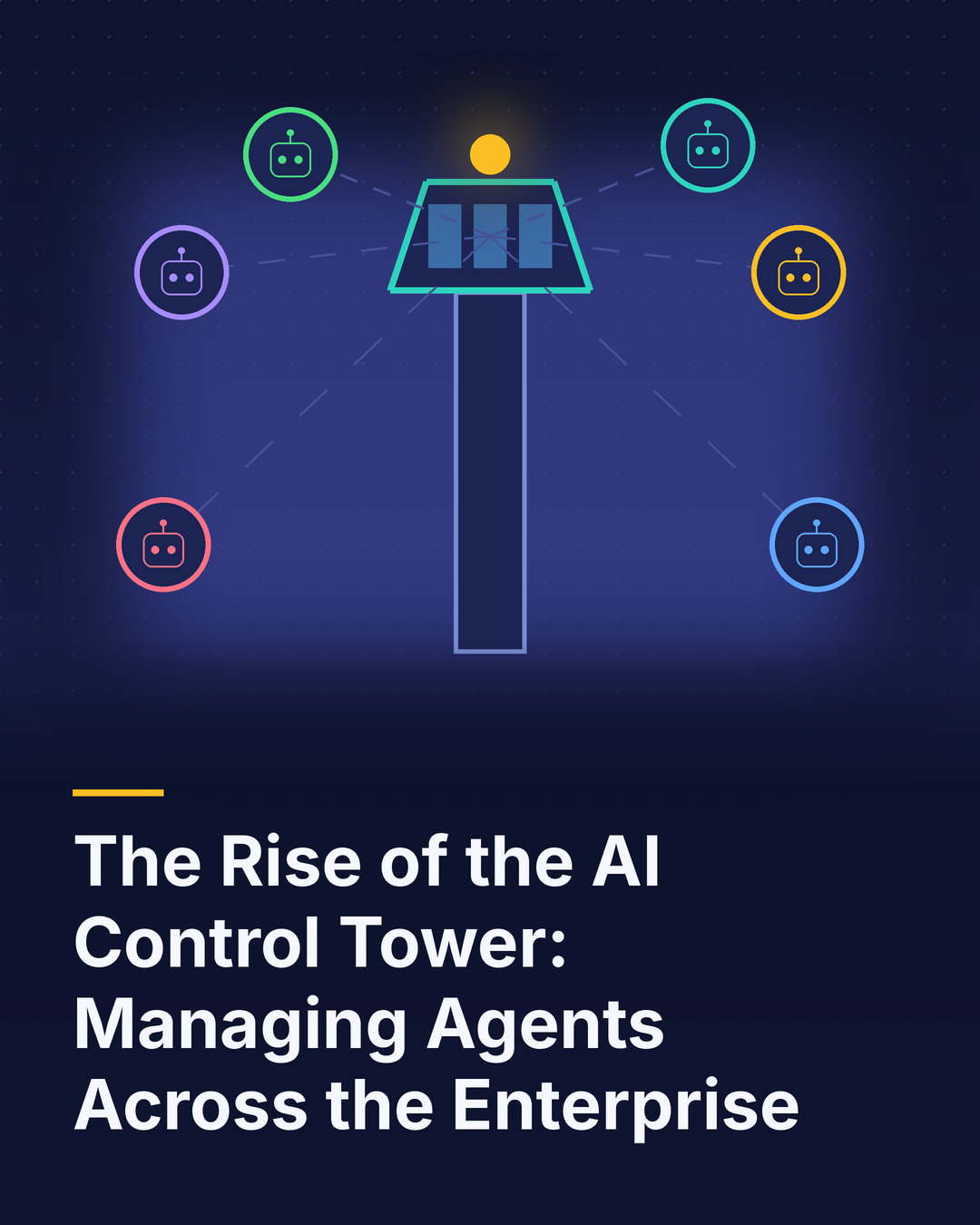
Airports offer a useful analogy for the challenge now facing enterprise technology leaders. Hundreds of aircraft, operated by different airlines and crews, move through shared airspace and runways each day. Individually, each pilot is highly capable. Collectively, without a control tower coordinating their movements, the result would be chaos and considerable danger.
I find this analogy increasingly apt as organizations begin to deploy AI agents in numbers. A single agent, operating within a well-defined workflow, is manageable. Dozens or hundreds of agents, built by different teams, sourced from different vendors and acting across many systems, present a different order of challenge altogether.
The Coming Proliferation of Agents
AI agents are arriving through several routes at once. Enterprise software vendors are embedding agents in their applications. Internal teams are building agents for specific processes. Business units are experimenting with agent-building tools on their own initiative. Within a few years, a large organization may operate a substantial population of agents, many with the ability to read sensitive data and take consequential actions.
Without central oversight, several risks emerge: agents with excessive permissions, duplicated effort across teams, conflicting actions on the same systems, unmonitored costs and an inability to answer a regulator’s straightforward question about which AI systems are acting on the organization’s behalf.
What an AI Control Tower Provides
A control tower approach establishes a central point of visibility and governance across all AI agents, regardless of where they were built. Its core functions include:
- Inventory. A complete register of agents, their owners, purposes, underlying models and the systems they can access.
- Policy and permissions. Consistent rules governing what each agent may do, with access limited to what its task requires.
- Monitoring. Continuous observation of agent activity, performance, accuracy and cost.
- Orchestration. Coordination of agents that collaborate on multi-step processes, ensuring that handoffs between agents and humans occur cleanly.
- Audit and accountability. A complete record of agent actions for compliance, investigation and continuous improvement.
- Lifecycle management. Controlled processes for approving, updating, testing and retiring agents.
Building on Existing Foundations
In my view, organizations should not treat agent governance as an entirely new discipline. Much of what is required, including asset inventories, access management, change control, service-level monitoring and audit trails, already exists in mature IT service management practices. Extending these practices, ideally on the same platform that orchestrates enterprise workflows, is far more efficient than building a separate governance apparatus from scratch.
The Bottom Line
As AI agents multiply across the enterprise, central oversight becomes essential to manage risk, cost and coordination. An AI control tower provides the inventory, policy enforcement, monitoring, orchestration and audit capability that a growing population of agents requires. Organizations that establish this oversight early will be able to expand their use of agents confidently, while those that do not may find themselves managing an unruly fleet they cannot fully see. As with air traffic, the purpose of the tower is not to slow anyone down, but to allow many capable actors to move quickly and safely at the same time.