
Beyond the Chatbot: How AI Agents Are Rewriting the Contact Center Playbook
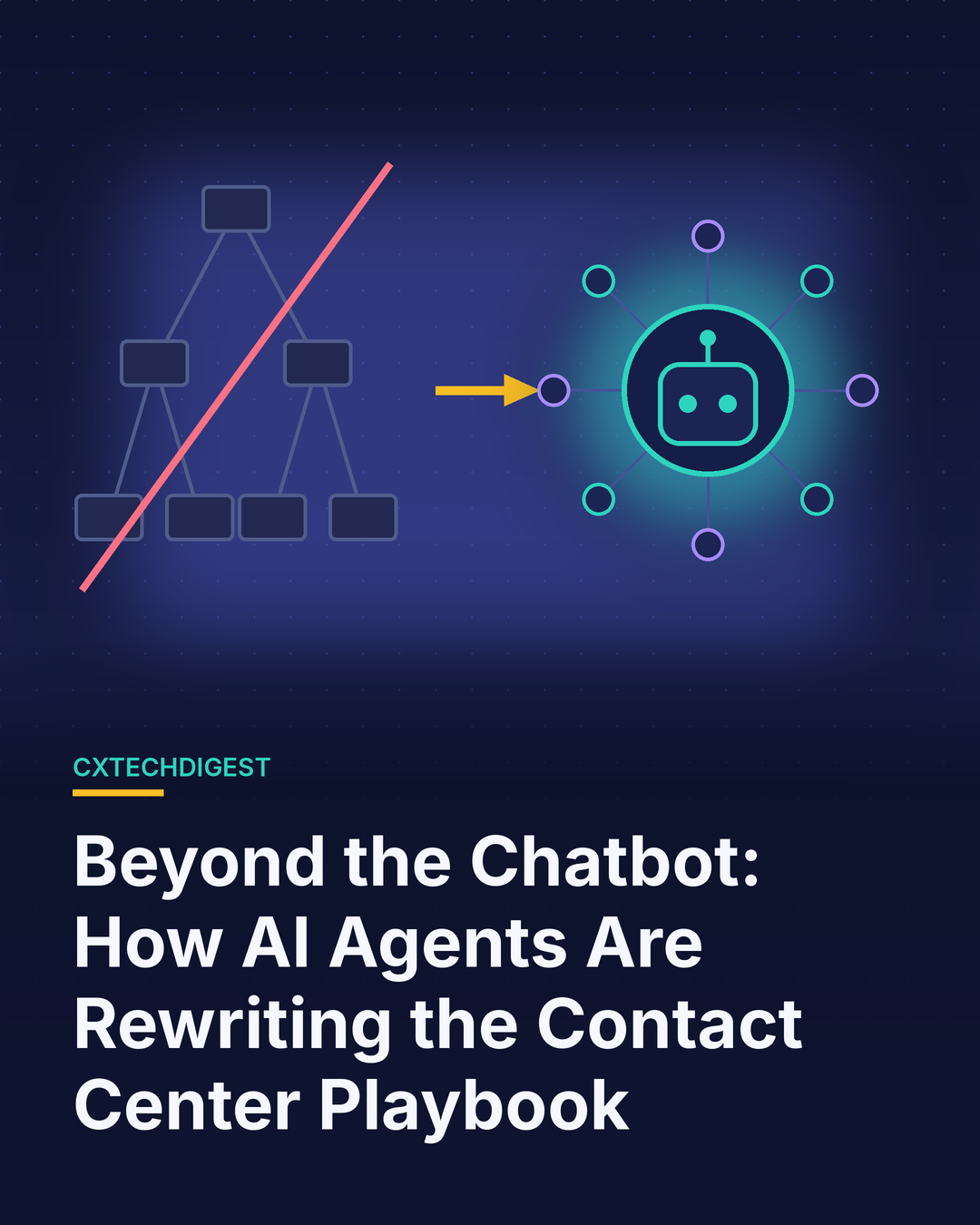
For most of the last decade, contact center automation meant decision-tree chatbots and IVR menus. Customers learned to hate them. They answered a narrow set of questions, misunderstood anything phrased unexpectedly, and too often trapped people in loops before finally offering a phone number.
AI agents are a different technology with different implications. Built on large language models and connected to business systems, they understand natural language, reason through multi-step requests and take action. That changes not just the front end of customer service, but how the entire contact center is designed, staffed and measured.
What’s actually different
From scripts to goals. Chatbots followed predefined flows. AI agents are given goals, policies and tools, and work out how to resolve the request. A customer who asks to change a flight, add a bag and use a travel credit in one sentence no longer has to navigate three menus.
From answering to doing. Agents connected to order, billing and account systems can complete transactions, not just describe how.
From single channel to every channel. The same agent can operate across chat, messaging, email and voice, maintaining context as customers switch channels.
From static to continuously improving. Agents learn from new knowledge articles, policy updates and conversation reviews far faster than retraining a decision tree.
The new playbook
1. Redesign around intent, not channel. Start by mapping the top customer intents by volume and complexity. Decide which ones AI agents should fully resolve, which they should prepare for humans, and which should go directly to people. This replaces channel-based routing with intent-based design.
2. Treat knowledge as infrastructure. AI agents are only as good as the information they draw on. Contact centers are creating knowledge operations teams responsible for keeping content accurate, consistent and structured for AI use.
3. Rethink the human role. As routine contacts move to AI, human agents handle more complex, emotional and high-value interactions. That requires different hiring profiles, more training in problem-solving and empathy, and often higher pay for higher-skill work.
4. Create new roles. Conversation designers, AI trainers, quality analysts for AI interactions and automation operations managers are becoming standard positions in modern contact centers.
5. Update the metrics. Average handle time and containment rate lose meaning when AI handles the easy calls and humans handle the hard ones. Focus on resolution rate, repeat contacts, customer effort, satisfaction and cost per resolution across both AI and human channels.
6. Govern carefully. Define what agents can do autonomously, set financial and policy limits, monitor for errors and hallucinations, and be transparent with customers about when they’re speaking with AI.
Common mistakes
- Automating broken processes instead of fixing them first
- Measuring success by deflection while customer satisfaction falls
- Making it hard to reach a human, which erodes trust quickly
- Underinvesting in back-end integration, leaving agents able to talk but not act
The bottom line
AI agents aren’t a better chatbot. They’re a new operating model for customer service. Contact centers that redesign processes, roles and metrics around that model will deliver faster, more effective service at lower cost. Those that simply bolt AI onto old workflows will recreate the frustrations customers already know too well.