
Connected Construction: Why Integrated Platforms Outperform Point Solutions
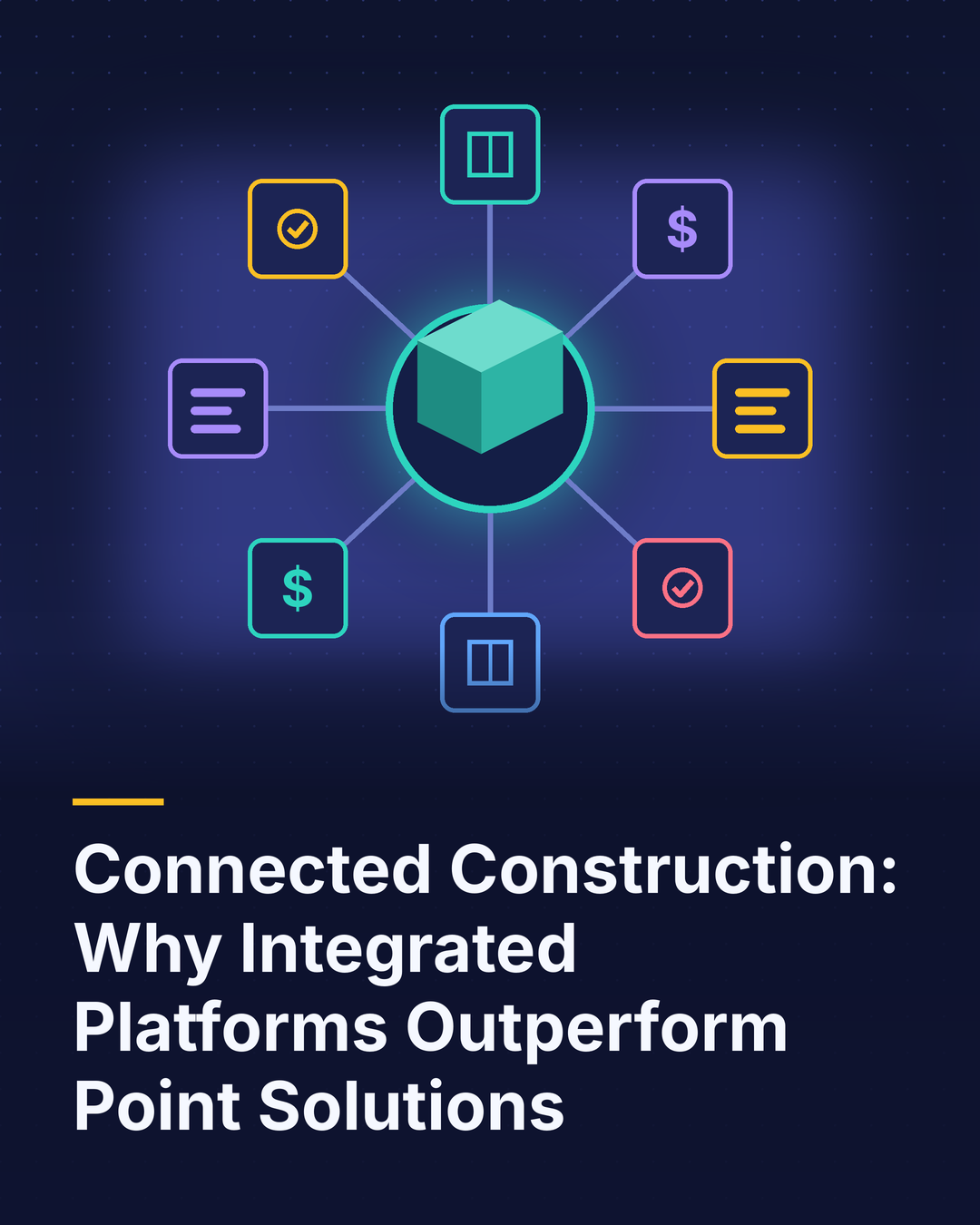
Walk into the technology stack of a typical general contractor and you’ll often find a dozen or more tools. One for bid management, one for takeoff, another for estimating. A document management system, a separate field app, an RFI log, a quality and safety tool, a scheduling program, an accounting system and a handful of spreadsheets filling the gaps between them.
Each tool was probably chosen for a good reason. The trouble is what happens between them.
The cost of the gaps
Every time information moves from one tool to another, someone has to export it, re-enter it or reconcile it. Drawings get uploaded in three places. Subcontractor details live in four. A design change has to be manually carried from the document system to the estimate, the schedule and the field app. Each handoff costs time and creates opportunities for error.
The gaps also limit visibility. When data lives in silos, it’s hard to answer simple cross-functional questions, such as how open RFIs are affecting the schedule, or which subcontractors are generating the most quality issues and change orders.
What integration changes
Integrated platforms connect preconstruction, design collaboration, project management, field execution and handover around a shared set of data. Information is entered once and used many times. Drawings, models, issues, RFIs, submittals and cost data reference each other directly. Field updates appear in the office immediately, and the project record builds itself as work progresses.
That consistency also makes analytics and AI far more useful, since the data is structured and complete rather than scattered across systems.
Point solutions still have a place
None of this means every specialized tool should be replaced. Some point solutions are excellent at what they do, and some workflows are unique to a firm or trade. The goal is a connected core platform for the information that flows across the project lifecycle, with open integrations for specialized tools that genuinely add value.
Questions to ask
How many times is the same information entered across our tools? Where do handoffs break down? Can we see a single, current view of a project’s status? Those answers usually make the case clearly.
The bottom line
Construction is a team sport, and fragmented technology makes teamwork harder. Integrated platforms reduce duplicate work, improve data quality and give everyone from estimators to superintendents the same picture of the project. As margins tighten and projects grow more complex, that shared foundation is becoming less of a nice-to-have and more of a competitive necessity.