
Fixed Wireless Access: A Faster Way to Connect Branch Offices and Pop-Up Locations
A retailer signs a lease for a new store. The fixtures arrive, staff are hired and the grand opening is scheduled. Then the wired internet provider says installation will take six weeks, maybe longer if construction permits are needed to run new lines. Without connectivity, there are no point-of-sale systems, no inventory updates and no security cameras.
This scenario plays out constantly for multi-location businesses. Fixed wireless access, or FWA, offers a faster path.
What fixed wireless access is
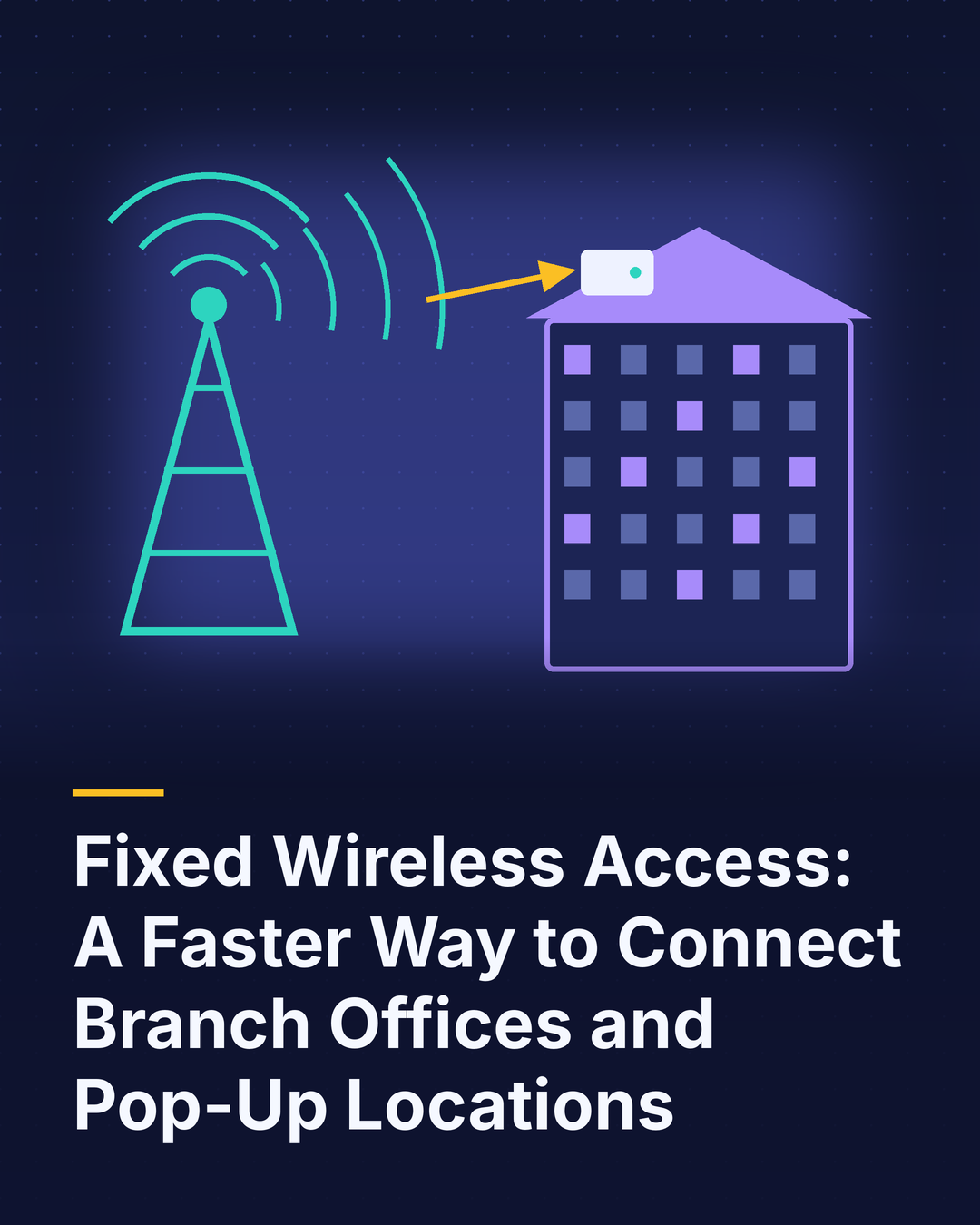
FWA delivers broadband internet to a fixed location using a cellular network, typically 5G or 4G LTE, instead of cable or fiber. A small receiver or router, placed near a window or mounted outside, connects to nearby cell towers and provides Wi-Fi and wired connections inside the building.
Because no trenching or cable installation is required, service can often be up and running in days, sometimes the same day the equipment arrives.
Where it fits best
New branch openings. Get stores, clinics or offices online immediately instead of waiting weeks for a wired circuit.
Pop-up and temporary sites. Construction trailers, seasonal retail, event booths, disaster recovery centers and mobile clinics can be connected quickly and moved when the job is done.
Backup connectivity. Pairing FWA with a wired primary connection keeps critical systems online if a cable is cut or a provider has an outage.
Underserved locations. Rural or hard-to-reach sites where wired options are limited or expensive.
Small offices. For many smaller locations, 5G fixed wireless offers speeds that comfortably support everyday business needs.
Questions to ask
FWA performance depends heavily on local signal strength and network capacity. Before deploying, test coverage at the specific address, confirm speed expectations during busy hours, and ask about data limits, business support terms and service-level commitments. For locations with heavy upload needs or strict latency requirements, a wired connection may still be the better primary option, with FWA as backup.
Centralized management is worth considering too. Some business FWA solutions let IT monitor and manage routers across many locations from a single dashboard.
The bottom line
Fixed wireless access turns connectivity from a construction project into a delivery. For businesses opening new locations, running temporary sites or protecting against outages, it offers speed and flexibility that wired options often can’t match. As 5G coverage expands, it’s becoming a standard part of the multi-site networking toolkit. The smartest approach is usually a mix: wired where it makes sense, wireless where speed and flexibility matter most.